
FCRA Registration in India – Process, Documents, Eligibility & Complete Guide
If your organization plans to receive foreign donations, FCRA registration is not optional — it is a statutory requirement under Indian law. Whether you are a trust, society, or Section 8 company, understanding the FCRA framework is essential before accepting any foreign contribution.
In this detailed guide, we’ll break down the FCRA full form, explain what FCRA is, clarify what FCRA registration means, and walk you through the complete FCRA registration process, required documents, eligibility criteria, compliance obligations, and frequently asked questions.
This guide is structured to help NGOs, compliance officers, trustees, and legal professionals understand the regulatory landscape governed by the Foreign Contribution (Regulation) Act, 2010.

FCRA Full Form – What is FCRA?
The FCRA full form is Foreign Contribution (Regulation) Act. It is a central legislation enacted to regulate the acceptance and utilization of foreign contribution or foreign hospitality by individuals, associations, and companies in India.
When people search “what is FCRA,” they are generally trying to understand:
- Why foreign donations are regulated
- Who can receive foreign funds
- How foreign contributions are monitored
The purpose of FCRA is to ensure that foreign contributions do not adversely affect: - National interest
- Internal security
- Public order
- Democratic institutions
Under FCRA, organizations must obtain prior approval or registration before receiving any FCRA fund, meaning any donation, delivery, or transfer from a foreign source.
An FCRA fund includes:
- Monetary donations from foreign entities
- Grants from international foundations
- Contributions from foreign citizens
- Foreign securities
- Certain articles exceeding prescribed value
It does not matter whether the amount is large or small — if the source qualifies as foreign under the Act, FCRA compliance applies.
What is FCRA Registration?
While understanding what FCRA is provides conceptual clarity, many organizations specifically search “what is FCRA registration.”
FCRA registration is the official approval granted by the Ministry of Home Affairs (MHA), Government of India, that allows eligible NGOs and associations to legally receive foreign contributions on a regular basis.
There are two pathways:
- FCRA Registration (Regular Registration)
- FCRA Prior Permission
Regular FCRA registration is granted to organizations with a proven track record of activities. Prior permission is granted for receiving a specific foreign contribution from a specific donor for a defined purpose.
Without FCRA registration or prior permission, accepting foreign donations is unlawful and can lead to penalties, cancellation of registration, and legal action.
Who is Eligible for FCRA Registration?
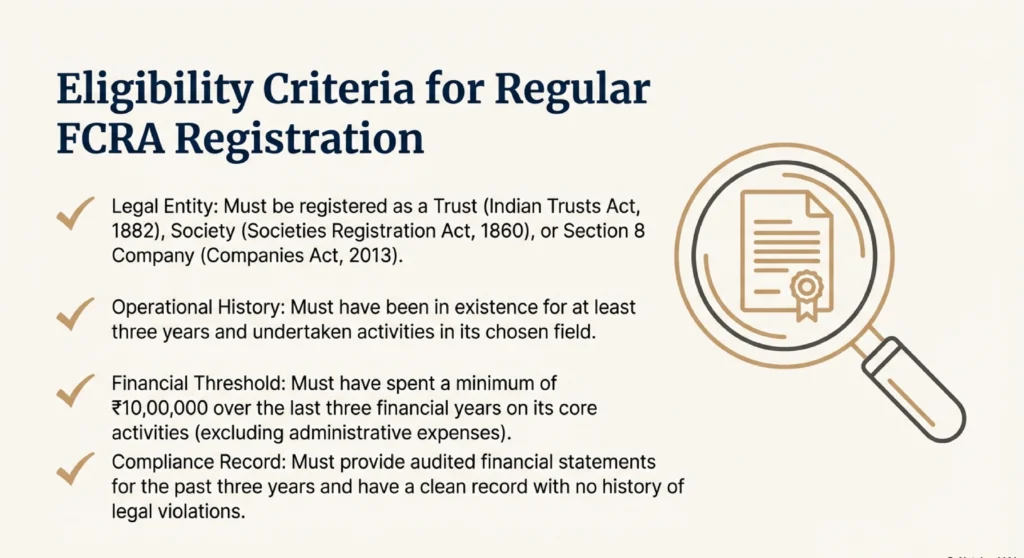
Eligibility is a crucial part of NGO FCRA registration. Not every organization automatically qualifies.
Eligible Entities
- Public charitable trusts
- Registered societies
- Section 8 companies
- Educational institutions
Basic Eligibility Conditions
- Cultural associations
- To apply for regular FCRA registration, an NGO must:
- Be legally registered under Indian law
- Have a minimum of three years of existence
- Have undertaken reasonable activity in its chosen field
- Have spent a minimum amount (as prescribed) toward its objectives
Key Compliance Pre-Conditions
- Dedicated FCRA bank account in the designated branch of State Bank of India (New Delhi Main Branch as mandated)
- No prosecution or conviction of office bearers for diversion of funds
- Clean compliance history
Organizations that are newly formed but have a specific confirmed foreign donor may apply under prior permission instead of full FCRA registration.
FCRA Registration Process – Step-by-Step Procedure
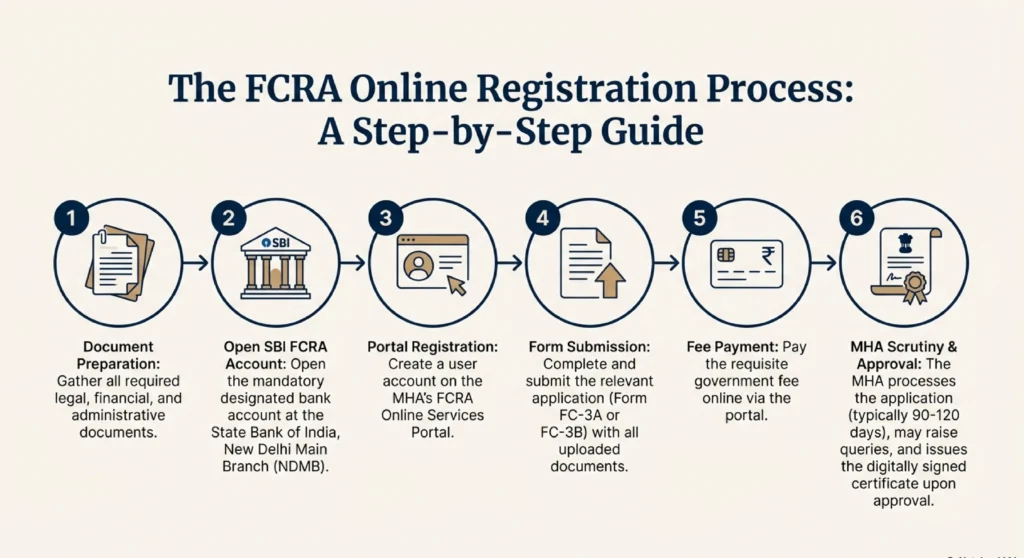
Understanding the FCRA registration process helps avoid delays and rejections. Below is a structured overview.
Overview of the FCRA Registration Process
| Step | Stage | Description | Key Requirement |
|---|---|---|---|
| 1 | Micro Enterprise | Up to Rs. 1 crore | Up to ₹5 Crore |
| Small Enterprise | Small Enterprise | Up to ₹10 Crore | Up to ₹50 Crore |
| Medium Enterprise | Medium Enterprise | Up to ₹50 Crore | Up to ₹250 Crore |
| Medium Enterprise | Medium Enterprise | Up to ₹50 Crore | Up to ₹50 Crore |
| Medium Enterprise | Medium Enterprise | Up to ₹50 Crore | Up to ₹50 Crore |
| Medium Enterprise | Medium Enterprise | Up to ₹50 Crore | Up to ₹50 Crore |
Step 1 – Eligibility & Pre-conditions
Before initiating the FCRA registration process:
- Ensure statutory registrations are valid
- Review activity reports of past three years
- Confirm financial transparency
- Pass board resolution approving FCRA application
Incomplete groundwork is a common reason for rejection.
Step 2 – FCRA Account Opening
Every applicant must open a designated FCRA account at:
State Bank of India
New Delhi Main Branch
This account is exclusively for receiving foreign contribution. Additional utilization accounts may be opened after receipt.
Failure to open the prescribed FCRA account will result in application rejection.
Step 3 – Online Application Filing
Applications are submitted online through the MHA FCRA portal.
Forms used:
- FC-3A → For FCRA registration
- FC-3B → For prior permission
Details required include:
- Organizational information
- Key functionary details
- Aadhaar / identification details
- Activity domain
- Financial summary
Accuracy here is critical. Inconsistent disclosures can trigger scrutiny.
Step 4 – Government Scrutiny & Approval
After submission:
- The application undergoes background verification
- Intelligence and local authority checks may be conducted
- Compliance track record is examined
If satisfied, the government grants FCRA registration. If not, the application may be rejected with reasons recorded.
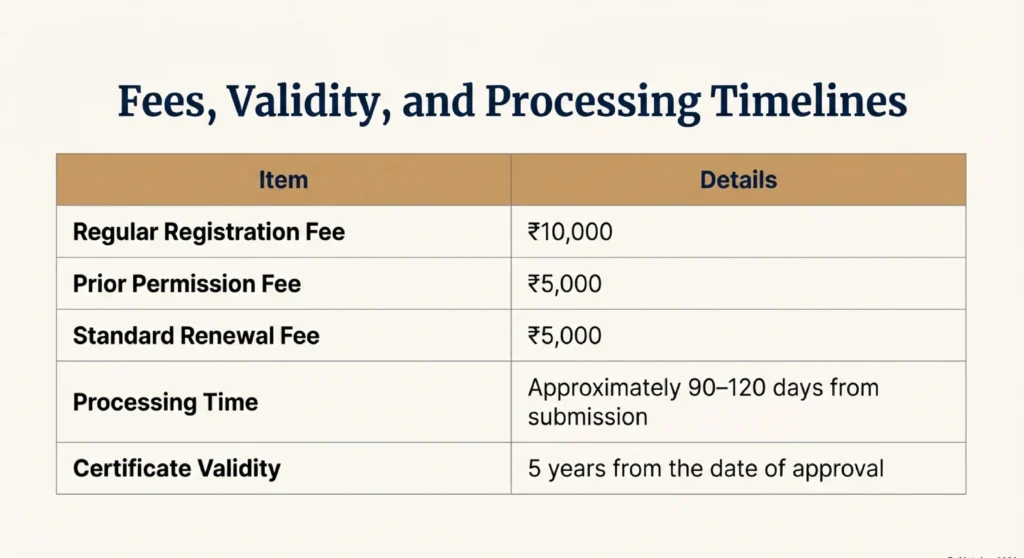
The entire FCRA registration process typically takes several months depending on scrutiny level.
Step 5 – Document Submission
Applicants must upload scanned copies of supporting documents. These are reviewed for legal and financial consistency.
FCRA Registration Documents Required
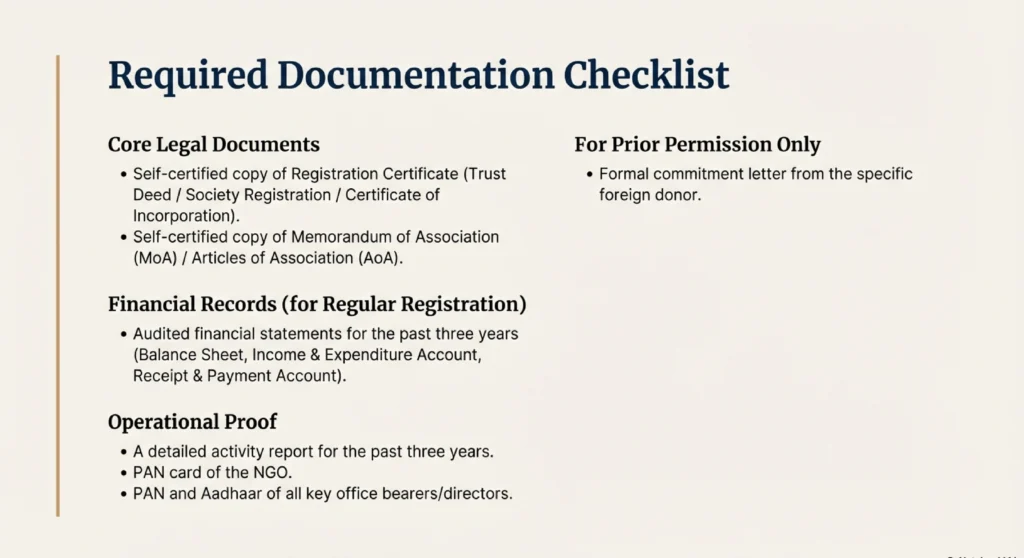
Many applicants specifically search for “FCRA registration documents required” before filing. Below is a consolidated checklist.
Mandatory Documents
- Certificate of registration of NGO
- Memorandum of Association / Trust Deed
- Activity report of past three years
- Audited financial statements of last three years
- Board resolution approving FCRA application
- Details of key functionaries
- Commitment letter from foreign donor (for prior permission cases)
Ensure:
- Documents are self-certified
- Names and details match across records
- Financial statements are consistent with reported activities
Missing or inconsistent documentation is a frequent reason for rejection.
Types of FCRA Registration
- Granted to established NGOs
- Valid for five years
- Allows ongoing receipt of foreign contribution
- For newly formed NGOs
- For a specific donor and specific project
- One-time approval
Choosing the correct category is important for compliance planning.
FCRA Fund – What Qualifies as Foreign Contribution?
Understanding what qualifies as an FCRA fund prevents unintentional violations.
Foreign contribution includes:
- Donation from foreign citizens
- Contribution from foreign corporations
- Grants from international agencies
- Transfer from foreign foundations
However, funds from: - Indian citizens (even if residing abroad)
- Indian companies
May not always qualify as foreign contribution, depending on shareholding structure and source classification.
NGOs must carefully evaluate donor classification before accepting funds.
Validity, Renewal & Compliance Requirements
FCRA registration is valid for five years from the date of approval.
Renewal application must be filed six months before expiry.
Organizations must:
- File annual return in Form FC-4
- Maintain proper books of accounts
- Report utilization of funds
- Ensure administrative expense limits are followed
Failure to comply may result in:
- Suspension
- Cancellation
- Penalty
Compliance discipline is as important as obtaining FCRA registration.
Common Reasons for Rejection of FCRA Registration
Understanding rejection risks strengthens your application strategy.
Common reasons include:
- Incomplete documentation
- Insufficient track record
- Inconsistency in financial statements
- Adverse background reports
- Improperly defined objectives
- Political or sensitive affiliations
A proactive internal audit before filing significantly reduces risk.
FCRA FAQ
FCRA stands for Foreign Contribution (Regulation) Act.
It is government approval allowing NGOs to legally receive foreign contributions.
Processing time varies but may take several months depending on scrutiny.
A new NGO cannot obtain regular FCRA registration immediately but may apply under prior permission if a specific foreign donor is confirmed.
Core documents include registration certificate, trust deed or memorandum, audited accounts, activity reports, and board resolution.
Yes. Without FCRA registration or prior permission, accepting foreign contribution is illegal.
An FCRA fund refers to any foreign contribution received from a foreign source as defined under the Act.
Final Thoughts
FCRA compliance is not merely procedural — it is regulatory and strategic. NGOs that plan to scale operations through international grants must treat FCRA registration as foundational infrastructure.
A well-prepared application includes:
- Clear documentation
- Consistent financial disclosures
- Transparent objectives
- Strong governance structure
By understanding the FCRA full form, what FCRA registration entails, the detailed FCRA registration process, and the FCRA registration documents required, organizations can significantly improve approval probability while maintaining long-term compliance.
If your NGO intends to receive foreign contributions, begin preparation early. Proper structuring today prevents regulatory complications tomorrow