
Trust PAN Card: Complete Guide to PAN Card for NGO and Charitable Trust
Non-governmental organizations (NGOs), charitable trusts, and societies in India often handle donations, grants, and financial transactions. To manage these activities legally and maintain tax compliance, these organizations must obtain a Permanent Account Number (PAN). A trust PAN card acts as the official tax identity of the organization and is required for financial operations regulated by the Income Tax Department of India.
Whether you are starting a charitable organization or managing an existing trust, understanding the NGO PAN card process is essential. Many trustees search for information on how to apply PAN card for trust, what documents are required, and how long the process takes.
This complete guide explains everything you need to know about getting a trust PAN card, including eligibility, application steps, required documents, fees, and common mistakes to avoid.
What Is a Trust PAN Card?
A trust PAN card is a Permanent Account Number issued specifically to a charitable trust, NGO, or similar organization for taxation and financial identification purposes.
Just like individuals and companies, organizations must have a unique PAN to conduct financial transactions in India. The PAN is a 10-digit alphanumeric identifier issued by the Income Tax Department of India that helps track financial activities and tax compliance.
For trusts and NGOs, the PAN card serves several important functions:
- It acts as the official tax identification number for the organization.
- It enables the trust to file income tax returns.
- It is required for opening a bank account in the name of the trust.
- It helps maintain financial transparency for donations and grants.
Without a trust PAN card, an organization may face difficulties in conducting legitimate financial operations. That is why obtaining a PAN is one of the first steps after registering a charitable trust or NGO.
Why NGOs and Charitable Trusts Need a PAN Card
Many organizations wonder whether a NGO PAN card is mandatory. In most practical situations, the answer is yes.
A trust or NGO must obtain a PAN card to legally manage its finances and comply with tax regulations.
Below are the major reasons why a trust PAN card is essential.
Charitable trusts and NGOs must file annual income tax returns, even if they qualify for exemptions. A PAN card is required to file these returns and maintain tax records.
Banks require a trust PAN card before allowing an organization to open a bank account. Without it, managing donations and operational funds becomes extremely difficult.
Donors and funding agencies often verify the PAN details of an organization before making donations. An NGO PAN card increases credibility and transparency.
Organizations seeking tax benefits such as registration under Section 12A or 80G must provide their PAN details during the application process.
PAN is mandatory for many high-value financial transactions, including property purchases, investments, and institutional funding.
In short, the trust PAN card acts as the foundation for financial compliance and legal recognition.
Who Can Apply for a PAN Card for Trust or NGO
Several types of organizations can apply for a PAN card under the category of trusts or institutions.
Eligible entities include:
- Public charitable trusts
- Private trusts
- Non-governmental organizations (NGOs)
- Registered societies
- Non-profit organizations
- Section 8 companies engaged in charitable work
Any organization involved in social, educational, religious, or charitable activities can apply for a trust PAN card once it has been legally established.
Typically, the application is submitted by a trustee, authorized representative, or managing member of the organization.
Before you apply PAN card for trust, ensure that the organization has at least basic documentation such as the trust deed or registration certificate.
How to Apply PAN Card for Trust (Step-by-Step Process)
Many trustees assume that the PAN application process is complicated, but in reality it is quite straightforward. The process can be completed either online or offline through authorized service providers.
Applications are usually processed through government-approved agencies such as NSDL e-Governance Infrastructure Limited and UTI Infrastructure Technology and Services Limited.
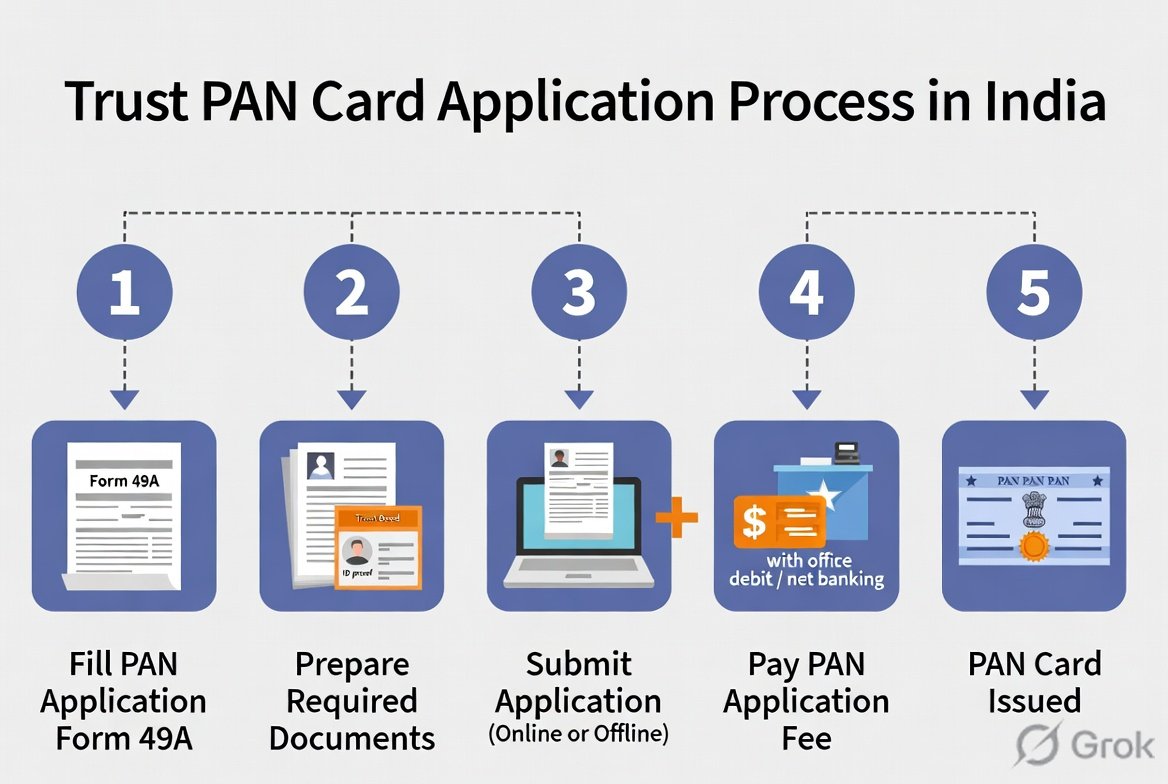
Below is the step-by-step process to apply PAN card for trust.
To obtain a trust PAN card, the organization must complete Form 49A, which is the standard PAN application form for Indian entities.
The form requires details such as:
- Name of the trust or NGO
- Date of formation
- Registered office address
- Type of organization
- Contact information
- Details of authorized trustee or representative
It is important to ensure that the name entered in the form matches exactly with the trust deed or registration certificate.
Before submitting the application, gather all necessary documents. These documents help verify the identity and legal existence of the trust.
Some of the key documents include:
- Trust deed or registration certificate
- Address proof of the organization
- Identity proof of the authorized trustee
- Passport-size photograph of the applicant
- Proof of date of formation
Submitting clear and accurate documents helps avoid delays in the NGO PAN card application process.
After completing the form and preparing the documents, the application can be submitted through two methods.
Online method
Applicants can submit the form through the websites of:
- NSDL e-Governance Infrastructure Limited
- UTI Infrastructure Technology and Services Limited
This is the fastest and most convenient way to apply PAN card for trust.
Offline method
Applicants can also download the form, fill it manually, and submit it at authorized PAN service centers.
Once the form is submitted, the applicant must pay the required application fee.
Payment options typically include:
- Debit card
- Credit card
- Net banking
- Demand draft (for offline applications)
After payment, the applicant receives an acknowledgment number that can be used to track the application status.
Once the application is submitted, the authorities review the documents and verify the information provided.
If everything is correct, the trust PAN card is generated and dispatched to the registered address of the organization.
In most cases, the PAN card is issued within a few working days.
Documents Required for Trust PAN Card Application
Providing accurate documentation is one of the most important steps when applying for a trust PAN card.
Below is a table summarizing the commonly required documents.
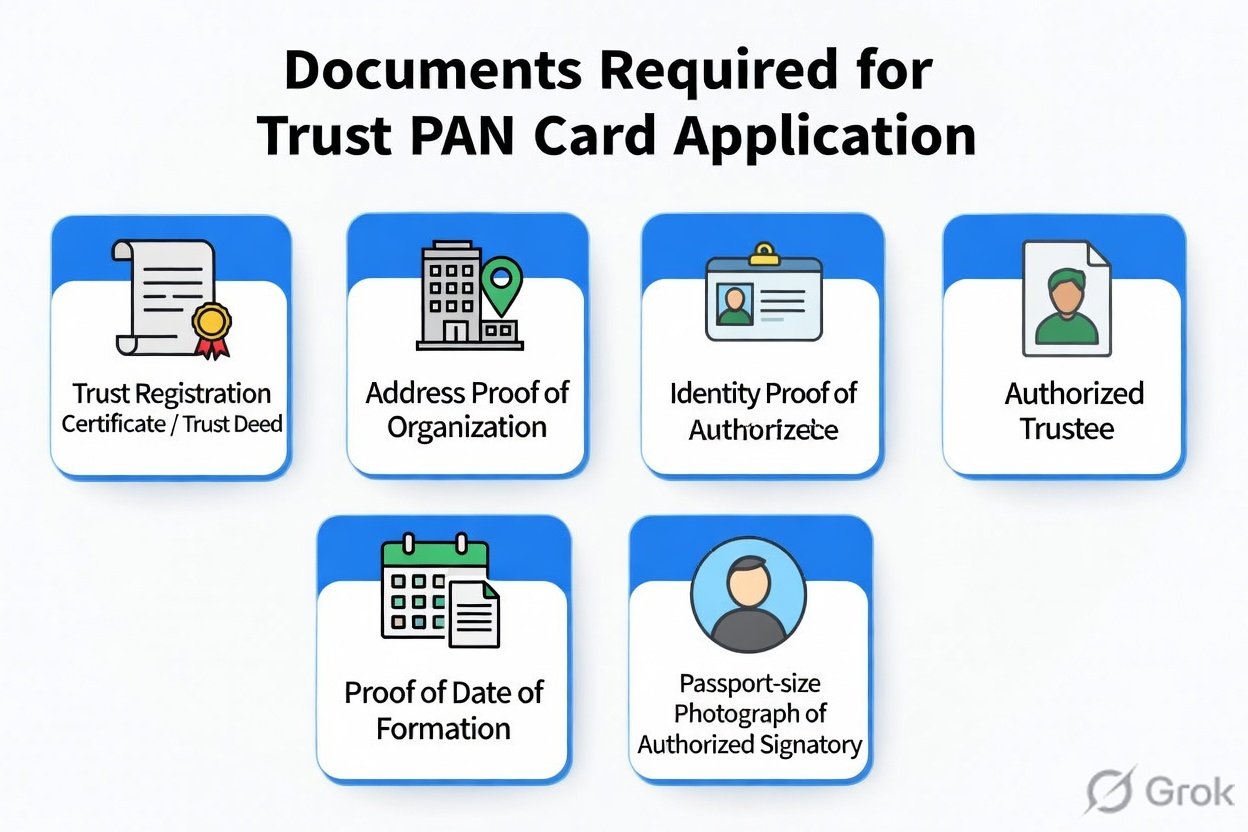
| Document Type | Examples | Purpose |
|---|---|---|
| Trust Registration Proof | Trust deed, society registration certificate | Confirms legal existence of the organization |
| Address Proof | Utility bill, registration certificate address | Verifies registered office location |
| Identity Proof of Trustee | Aadhaar card, passport, voter ID | Confirms identity of authorized person |
| Date of Formation Proof | Trust deed or certificate | Confirms organization establishment date |
| Photograph | Passport-size photo of authorized signatory | Used for identification |
Before submitting your application, make sure that all documents are self-attested and clearly readable.
Incomplete or incorrect documentation is one of the most common reasons for rejection of NGO PAN card applications.
Online vs Offline PAN Application for NGOs
Organizations can apply for a trust PAN card using either an online or offline process.
Both methods ultimately lead to the same result, but they differ in convenience and processing time.
Below is a comparison of both options.
| Application Method | Process | Processing Time | Convenience |
|---|---|---|---|
| Online Application | Fill form digitally and upload documents | Faster | High |
| Offline Application | Submit physical form at service center | Slightly slower | Moderate |
For most organizations, the online method is recommended because it is faster and easier to track.
However, the offline option remains useful for applicants who prefer physical documentation or assistance from PAN service centers.
PAN Card Fees and Processing Time
The cost of obtaining a trust PAN card is relatively affordable.
The exact fee may vary slightly depending on whether the PAN card is delivered within India or internationally.
Typically, the PAN application fee covers:
- Processing of the application
- Verification of documents
- Printing of the PAN card
- Delivery to the registered address
Processing usually takes 7–15 working days, depending on the verification process and document accuracy.
Applicants who choose the online application method often receive updates through email or SMS regarding the status of their NGO PAN card.
Common Mistakes When Applying for NGO PAN Card
Many organizations face delays simply because of avoidable errors during the application process.
Understanding these common mistakes can help ensure your trust PAN card application is approved quickly.
The name entered in the PAN application must match the exact name mentioned in the trust deed.
Even small spelling differences can cause rejection.
Some applicants accidentally use the wrong form instead of Form 49A. This can delay the process significantly.
Missing documents such as identity proof or trust registration certificates often result in application rejection.
The registered office address must match the official documentation of the organization.
If the authorized trustee forgets to sign the application form, the request may be rejected during verification.
Avoiding these mistakes can help ensure a smooth NGO PAN card application process.
FAQ About Trust PAN Card
Yes. Most NGOs and charitable trusts require a trust PAN card to conduct financial transactions, open bank accounts, and file income tax returns.
Organizations must use Form 49A when they apply PAN card for trust or NGO registration purposes.
Yes. Trusts can easily apply online through authorized platforms such as NSDL e-Governance Infrastructure Limited or UTI Infrastructure Technology and Services Limited.
In most cases, the NGO PAN card is issued within 7 to 15 working days after successful verification.
No. The trust PAN card belongs to the organization itself, not to individual trustees.
Conclusion
Obtaining a trust PAN card is one of the most important steps for any NGO or charitable organization operating in India. The PAN number serves as the official tax identity of the organization and enables it to perform essential financial activities.
From opening bank accounts to filing tax returns and receiving donations, the NGO PAN card plays a vital role in maintaining financial transparency and legal compliance.
Fortunately, the process to apply PAN card for trust is simple. By completing Form 49A, preparing the required documents, and submitting the application through authorized agencies, organizations can obtain their PAN quickly and efficiently.
If you are managing or planning to establish an NGO or charitable trust, applying for a trust PAN card should be one of the first administrative steps. Doing so ensures that your organization operates smoothly, builds donor trust, and remains compliant with tax regulations.